

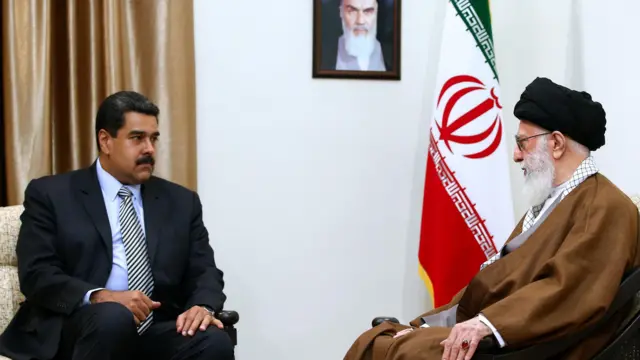
Aunque la estrategia de Donald Trump en Venezuela —eliminar al líder y negociar con figuras del aparato estatal para asegurar una transición favorable a EE.UU.— ha dado resultados rápidos, replicarla en Irán enfrenta obstáculos estructurales, geopolíticos y sociales que la hacen extremadamente improbable. Mientras en Venezuela el cambio de gobierno se logró con relativa fluidez tras la captura de Maduro, en Irán la eliminación del ayatolá Ali Jamenei y otras figuras clave ha desencadenado una guerra regional, no una transición política. La complejidad del Estado iraní, con su sistema teocrático, su ejército poderoso y su sociedad diversa, impide que una fórmula de “cambio de líder” funcione como en Caracas.
Irán no es Venezuela. Con 92 millones de habitantes —más del triple que Venezuela—, cuenta con una estructura política y militar altamente centralizada, donde el poder no reside solo en una figura, sino en una red de instituciones religiosas, militares y civiles interconectadas. Además, el Cuerpo de Guardianes de la Revolución Islámica (CGRI) tiene un control profundo sobre la seguridad, la economía y la política, lo que dificulta cualquier intento de “negociar con el aparato estatal” desde afuera. En Venezuela, la oposición y las fuerzas militares estaban fragmentadas; en Irán, la lealtad al régimen sigue siendo fuerte, incluso tras la muerte de Jamenei, y no hay una figura clara como Delcy Rodríguez que pueda asumir el poder con apoyo interno y externo.
La sociedad iraní también es más heterogénea, con minorías étnicas y religiosas que han sido históricamente marginadas, pero que ahora podrían aprovechar el vacío de poder para exigir autonomía o incluso independencia. Esto aumenta el riesgo de fragmentación y caos, en lugar de una transición ordenada. Además, la respuesta regional ha sido más intensa: países como Irak, Siria y Líbano, aliados de Irán, ya han movilizado fuerzas, y el conflicto ha escalado más allá de las fronteras iraníes. En Venezuela, la comunidad internacional, incluyendo a la OEA y países latinoamericanos, aceptó rápidamente el cambio; en Medio Oriente, la reacción es más polarizada y conflictiva.
Trump ha sugerido que podría “estar involucrado en el nombramiento” de un nuevo líder en Teherán, como lo hizo con Rodríguez. Pero en Irán, no hay una figura con legitimidad interna que pueda negociar con EE.UU. sin ser vista como traidora. La legitimidad política en Irán está profundamente arraigada en la ideología islámica y la resistencia antiimperialista, lo que hace que cualquier gobierno impuesto desde afuera sea rechazado por amplios sectores de la población. Incluso si EE.UU. lograra instalar un gobierno favorable, su estabilidad sería frágil y su duración, incierta.
En resumen, la estrategia de “cambiar al líder y negociar con el sistema” que funcionó en Venezuela no es transferible a Irán. Las diferencias en tamaño, estructura política, cohesión social y contexto regional hacen que cualquier intento de replicarla sea más probable que genere caos que estabilidad. La fórmula venezolana no es un modelo exportable, y en Irán, las consecuencias podrían ser mucho más graves —y duraderas—.
English version
Can the U.S. Replicate Its Venezuelan Strategy in Iran?
While Donald Trump’s strategy in Venezuela —removing the leader and negotiating with figures within the state apparatus to secure a transition favorable to the U.S.— yielded swift results, replicating it in Iran faces structural, geopolitical, and social obstacles that make it highly improbable. Whereas Venezuela’s government transitioned with relative ease after Maduro’s capture, Iran’s elimination of Ayatollah Ali Khamenei and other key figures has triggered a regional war, not a political transition. The complexity of the Iranian state, with its theocratic system, powerful military, and diverse society, prevents a “leader replacement” formula from working as it did in Caracas.
Iran is not Venezuela. With 92 million people —more than triple Venezuela’s population— it has a highly centralized political and military structure where power is not held by a single figure but by a network of religious, military, and civilian institutions. Moreover, the Islamic Revolutionary Guard Corps (IRGC) maintains deep control over security, the economy, and politics, making it difficult for any external actor to “negotiate with the state apparatus.” In Venezuela, opposition and military forces were fragmented; in Iran, loyalty to the regime remains strong even after Khamenei’s death, and there is no clear figure like Delcy Rodríguez who can assume power with both internal and external support.
Iranian society is also more heterogeneous, with ethnic and religious minorities historically marginalized but now potentially seeking autonomy or even independence amid the power vacuum. This increases the risk of fragmentation and chaos rather than an orderly transition. Additionally, the regional response has been more intense: countries like Iraq, Syria, and Lebanon —Iran’s allies— have already mobilized forces, and the conflict has escalated beyond Iran’s borders. In Venezuela, the international community, including the OAS and Latin American nations, quickly accepted the change; in the Middle East, the reaction is more polarized and conflictive.
Trump has suggested he could “be involved in the appointment” of a new leader in Tehran, as he did with Rodríguez. But in Iran, no figure with internal legitimacy can negotiate with the U.S. without being seen as a traitor. Political legitimacy in Iran is deeply rooted in Islamic ideology and anti-imperialist resistance, making any externally imposed government rejected by broad sectors of the population. Even if the U.S. managed to install a friendly government, its stability would be fragile and its longevity uncertain.
In summary, the “remove the leader and negotiate with the system” strategy that worked in Venezuela is not transferable to Iran. Differences in size, political structure, social cohesion, and regional context mean that any attempt to replicate it is more likely to generate chaos than stability. The Venezuelan formula is not an exportable model, and in Iran, the consequences could be far more severe —and enduring—.
Más Noticias
 20 enero, 2023 CUANDO CESARÁ LA TIERRA DE TENER TANTAS GUERRAS INÚTILES
- 23 marzo, 2020 LOS DETALLES DEL DECRETO DE CUARENTENA TOTAL NACIONAL
- 10 abril, 2024 Colombia reconoce, ante el Consejo de Seguridad de la ONU, el apoyo de la comunidad internacional a la Paz Total
- 29 julio, 2020 Decisiones Oportunas del Gobierno yCombinación de Medidas, Frente al Covid-19